





There’s a particular kind of internet story that refuses to die, no matter how many times it gets debunked, and the Bob Joyce Elvis theory is one of the best examples of it in recent memory. A soft-spoken pastor from Benton, Arkansas, spends decades quietly leading a small congregation, occasionally singing gospel songs in a voice that happens to sound uncannily like the King of Rock and Roll, and suddenly he’s at the center of a conspiracy theory that’s been shared millions of times across TikTok, YouTube, and Facebook. It sounds almost too strange to be real, yet here we are, still talking about it years after the first clips of Bob Joyce started circulating online.
If you’ve landed here after scrolling through a video that claims Elvis Presley faked his death in 1977 and has been living under a different name in the Ozarks ever since, you’re not alone. Millions of people have asked the same question: is Bob Joyce actually Elvis Presley? This article digs into where the theory came from, what the actual facts say, why the resemblance is so striking in the first place, and why so many people want so badly for it to be true. We’ll look at the timeline, the church he built, the family members who’ve been dragged into the speculation, and the broader psychology behind why Elvis “sightings” have never really stopped since the day he died.
Read Also: Who Is Veronika Khomyn? Inside Sean McVay’s Wife’s Life & Career
Who Is Bob Joyce, Really?
Bob Joyce is a pastor and gospel singer from Benton, Arkansas, who leads a congregation called Household of Faith. According to his own church’s history, he and his wife, Willena, started out modestly, meeting weekly with a small group of roughly seven or eight people. That’s not exactly the origin story of a global superstar hiding in plain sight — it’s the origin story of a small-town minister building a community one Sunday at a time.
By 2014, the congregation had grown enough to rent a commercial space on Salem Road. Three years later, in 2017, they moved into a larger section of the same building, one that could seat around 35 to 40 people during services. The church kept expanding gradually, and in 2019 it relocated to its current home at 5601 Salt Creek Road, a site that now includes classrooms, a fellowship hall, and enough seating for roughly 100 congregants, with parking for about 20 vehicles. It’s the kind of steady, unremarkable growth you’d expect from any small evangelical church in the American South, not the secret headquarters of a rock icon who supposedly vanished from public life half a century ago.
Bob Joyce was born on June 19, 1952, which makes him considerably younger than Elvis Presley would be today. Elvis was born on January 8, 1935, in Tupelo, Mississippi, meaning he would have been well into his nineties by now had he lived. That single detail — the age gap between the two men — is one of the simplest and most persuasive pieces of evidence against the theory, yet it rarely stops the speculation from spreading. People see the jawline, the sideburns, the curled lip, and the resemblance short-circuits their skepticism before the math even gets a chance to register.
What makes Bob Joyce genuinely interesting, aside from the conspiracy attached to his name, is that he’s also a talented gospel and country singer in his own right. His voice has a warm, husky quality with a similar vibrato to Presley’s, and when he performs classic gospel numbers, the resemblance in tone is genuinely startling, even to listeners who aren’t predisposed to conspiracy thinking. It’s easy to understand why the videos took off. Voice recognition is powerful, almost primal, and when a stranger sounds like someone we’ve spent our whole lives hearing, our brains jump to the simplest explanation rather than the statistically likely one.
How the Bob Joyce Elvis Rumor Started
The Bob Joyce Elvis theory didn’t emerge from a single dramatic moment. It built up slowly, the way most modern internet conspiracy theories do, through short clips rather than long investigations. Someone recorded Joyce singing during a service or a community event, posted it online, and the resemblance to Elvis was immediately obvious to viewers scrolling past. From there, the clips got reposted, remixed, and captioned with increasingly bold claims, and each new video pulled in fresh waves of curious viewers who had never heard of Bob Joyce before.
Long-time Elvis devotees played a significant role in fueling the theory. Fans such as Tom Mennel, who has followed Presley’s career and legacy for decades, publicly noted that Joyce’s voice and physical mannerisms seemed to line up almost too well with the King’s. That kind of endorsement from a self-identified expert lends a theory credibility it wouldn’t otherwise have, even when the “expert” in question has no forensic, medical, or investigative authority whatsoever. It’s a classic pattern in conspiracy culture: an enthusiast’s confident opinion gets treated as evidence, and the theory snowballs from there.
The Elvis-is-alive mythology long predates Bob Joyce, of course, and that existing cultural backdrop made his case land harder than it otherwise might have. Ever since Presley’s death on August 16, 1977, at Graceland in Memphis, Tennessee, a subset of fans has refused to accept the finality of it. Conspiracy theories pointed to inconsistencies in the way his body was handled, questioned why he was taken to Baptist Church Hospital roughly 15 miles away instead of a closer facility, and speculated about a supposedly staged death certificate. Decades of tabloid “Elvis sightings” — from grocery stores to gas stations to, now, a small Arkansas church — kept that flame alive long enough for a new face like Bob Joyce to slot right into an already familiar narrative.
Social media algorithms did the rest. Once a handful of videos about Bob Joyce began generating engagement, platforms like TikTok surfaced them to increasingly wide audiences, and copycat content followed almost immediately. Amateur “investigators” started publishing side-by-side photo comparisons, slowed-down audio clips, and dramatic voiceovers asking viewers to “decide for themselves.” That kind of content is inexpensive to produce and reliably generates views, which means the incentive to keep the Bob Joyce Elvis story alive online has very little to do with truth and everything to do with attention.
The Family Connection: Sons, Grandsons, and Viral Photos
One of the details that kept the Bob Joyce Elvis theory circulating longer than a typical lookalike story is the claim that his sons and grandsons bear a striking resemblance to Presley as well. Several viral posts have featured photos of Joyce’s family members, with captions suggesting that the resemblance running through multiple generations is too consistent to be coincidental. In one widely shared TikTok clip, a user claimed that Joyce’s grandson, identified as Ben, had leaked a new photo supposedly proving that his grandfather was Elvis all along.
These kinds of family-based claims tend to be especially effective at spreading conspiracy theories because they add a layer of supposed insider knowledge. A stranger’s opinion about a resemblance is one thing; a family member appearing to “confirm” it, even indirectly through a suggestive photo caption, feels like a much bigger revelation. In reality, family resemblance is an entirely mundane explanation for why multiple generations of the Joyce family might share similar jawlines, hairlines, or bone structure. Genetics don’t need a secret rock star hiding in the family tree to produce sons and grandsons who look like their father and grandfather.
It’s worth noting, too, that “genetic Elvis” theories tend to fall apart the moment you examine them for more than a few seconds. If Bob Joyce were secretly Elvis Presley living under an assumed identity since 1977, his biological children would have been born to Bob Joyce and Willena, not to Elvis and any of his known partners, which means there’s no plausible mechanism for Presley’s actual genetic material to be passed down through the Joyce family line in the first place. The resemblance, striking as it may be in certain photographs and lighting conditions, has to be attributed to ordinary genetic coincidence rather than a hidden bloodline.
Read Also: Who Is Pablo Huston? The Untold Story of Danny Huston’s Son
Did Bob Joyce Attend Lisa Marie Presley’s Funeral?
A separate but related rumor gained traction in early 2023, shortly after Lisa Marie Presley, Elvis’s only child, passed away on January 12 of that year. Online sleuths circulated a grainy photo from her funeral, claiming the man pictured was Bob Joyce himself, quietly slipping into the ceremony to pay respects to a daughter he had secretly fathered decades earlier. The claim spread quickly, feeding directly into the larger Bob Joyce Elvis narrative and giving it a fresh emotional hook tied to a real, recent tragedy.
The claim didn’t hold up. A YouTube channel that specializes in Elvis-related research and fact-checking identified the man in the photo as Andy Childs, a country and gospel musician who had genuine professional ties to the Presley family. Childs had collaborated with Lisa Marie Presley on a gospel album released in 2018, which explained his legitimate presence at her funeral far more convincingly than any secret-identity theory ever could. The resemblance between Childs and Joyce, both older men with similar builds and hairstyles, was simply enough to confuse casual viewers scrolling through low-resolution images on their phones.
This episode is worth dwelling on because it illustrates exactly how these theories metastasize. A blurry photo, an eager audience primed to believe, and a few confident captions are often all it takes to manufacture a “smoking gun” that later turns out to be nothing more than mistaken identity. The Bob Joyce Elvis story has repeated this pattern more than once, and each time the original claim gets quietly corrected, the correction travels a fraction as far as the original viral post did.
Has Bob Joyce Ever Confirmed He’s Elvis?
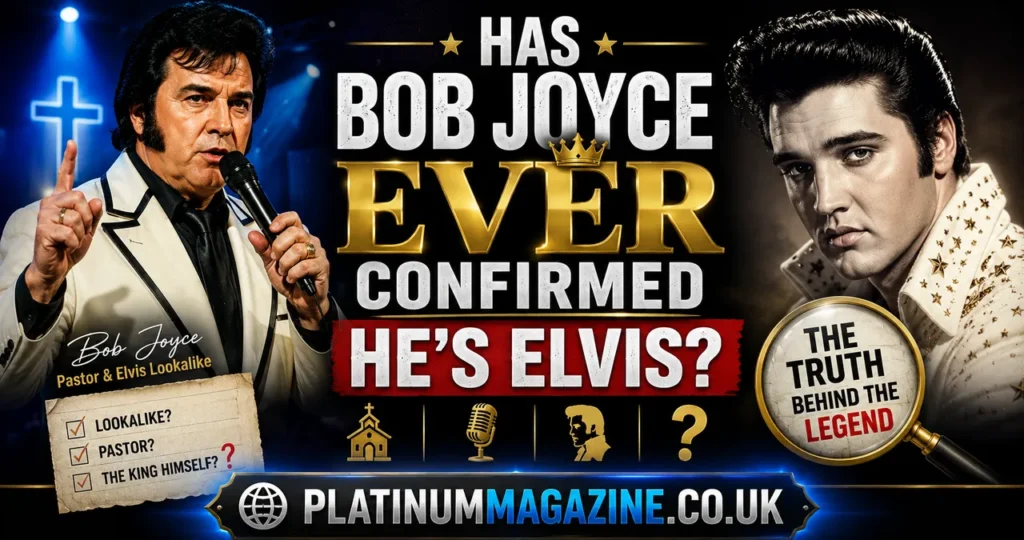
No, and he’s been remarkably consistent about it. Bob Joyce has addressed the rumors directly, including during sermons at his own church, stating plainly that he is not Elvis Presley and never has been. He’s described the whole situation as a strange but ultimately amusing case of mistaken identity, one that he says doesn’t change his focus on his ministry or his congregation. In interviews and public statements, he’s emphasized that while he’s aware many fans believe he’s connected to Presley, that belief doesn’t reflect reality no matter how persistently it circulates online.
What’s notable is that Joyce hasn’t tried to shut the conversation down aggressively or hide from the attention altogether. Instead, by most accounts, he’s treated it with a kind of good-humored patience, occasionally using the increased visibility as an opportunity to invite curious visitors to his church. Some of the coverage around the Bob Joyce Elvis phenomenon notes that his congregation has grown, at least in part, because people who came out of curiosity about the resemblance ended up staying for the message. That’s a fairly ordinary human response to unexpected fame, honestly, and it reads a lot more like a small-town pastor navigating an odd viral moment than a decades-long conspiracy unraveling in real time.
Skeptics have pointed out something else worth considering: if Bob Joyce really were Elvis Presley hiding under an assumed identity, publicly and repeatedly denying it on camera would be exactly the kind of behavior you’d expect from someone who had faked his death specifically to escape fame and scrutiny. Every flat denial, in other words, is at least as consistent with “he’s simply not Elvis” as it is with any secret-identity narrative, and the simpler explanation tends to be the correct one in the overwhelming majority of cases like this.
Read Also: Who Is Loralee Czuchna? The Untold Story of Matt Czuchna’s Sister
Comparing the Claims to the Facts
It helps to lay the actual comparison points side by side, because once you separate the emotional pull of the story from the verifiable details, the Bob Joyce Elvis theory becomes much easier to evaluate on its merits.
| Detail | Elvis Presley | Bob Joyce |
|---|---|---|
| Date of birth | January 8, 1935 (Tupelo, Mississippi) | June 19, 1952 |
| Age in 2026 | Would be 91 | In his early seventies |
| Reported death | August 16, 1977, Graceland, Memphis | Alive and active as of 2026 |
| Profession | Musician, actor, cultural icon | Pastor, gospel singer |
| Public role | Global superstar | Leader of a small Arkansas church |
| Family | Married Priscilla Presley; daughter Lisa Marie | Married to Willena; has sons and grandsons |
| Own statement on the theory | N/A (deceased) | Repeatedly denies being Elvis |
The age gap alone is difficult to reconcile with the “Elvis is alive and disguised as Bob Joyce” theory. A roughly 17-year difference between their birth years isn’t a rounding error; it’s the kind of gap that would require an entirely separate explanation on top of the original faked-death claim, and no version of the theory circulating online has ever offered one that holds up to scrutiny.
Why People Want to Believe It
There’s a deeper psychological current running underneath the Bob Joyce Elvis story that’s worth taking seriously, even while debunking the factual claims. Elvis Presley wasn’t just a musician; he was, and remains, one of the defining cultural figures of the twentieth century, someone whose death at 42 felt abrupt and, to many fans, unfinished. Grief that never gets full closure has a way of curdling into hope for an alternate ending, and “he’s actually still alive somewhere” is one of the most common forms that hope takes for beloved public figures who die young or under murky circumstances.
As one longtime Elvis fan put it while discussing the resemblance, people who’ve spent half a century following an artist develop an intimate, almost personal sense of their voice and mannerisms, which is exactly why a compelling lookalike can trigger such a strong emotional reaction. That kind of parasocial familiarity is powerful. It’s the same instinct behind decades of Elvis sightings at diners and airports, the same instinct behind persistent theories about other cultural icons whose deaths felt too sudden or too strange to accept at face value.
Bob Joyce himself has acknowledged this dynamic in his own way, suggesting that even though he’s not the King of Rock and Roll, his voice and message seem to offer something meaningful to people who are still, in their own fashion, mourning Presley’s absence decades later. Whether or not that framing is entirely comfortable for him, it captures something true about why this particular conspiracy theory has had such staying power compared to the countless other Elvis-sighting stories that have come and gone since 1977 without ever generating this much sustained attention.
There’s also a simpler explanation that shouldn’t be overlooked: doppelgängers are genuinely fascinating, and the internet has an enormous appetite for them regardless of any conspiracy angle. Videos of ordinary people who happen to look startlingly like celebrities routinely go viral on their own merits. Bob Joyce’s situation combines an unusually strong resemblance with a genuinely similar singing voice and a decades-old cultural mythology about Elvis faking his death, which is a nearly perfect storm for viral speculation. Remove any one of those three ingredients and it’s doubtful the story would have traveled nearly as far.
Read Also: Rebecca Sneed Net Worth 2026: The Real Story Behind Her Career, Marriage, and Wealth
What Skeptics and Researchers Say
Independent researchers and long-time Elvis historians have consistently pushed back on the Bob Joyce Elvis claims. A widely viewed YouTube breakdown titled “Why Pastor Bob Joyce Is NOT Elvis Presley” walks through the same evidence outlined here: the age discrepancy, the lack of any documentary or medical evidence supporting a faked death, and the far more mundane explanation of a striking natural resemblance combined with a similar vocal timbre. The creator, who admits to having once found the theory compelling, ultimately concludes that the facts simply don’t support it.
Public commentary on forums like Quora echoes the same skepticism. One frequent response from longtime Presley fans notes that while Bob Joyce has a pleasant singing voice, he lacks the vocal range, versatility, and stage charisma that made Elvis a once-in-a-generation performer. That’s a subjective judgment, admittedly, but it reflects a broader pattern among serious Elvis scholars and collectors: admiration for the resemblance, paired with firm rejection of the idea that resemblance equals identity. Even a well-known encyclopedia entry on Elvis Presley’s life and career, hosted on Wikipedia, documents his death in 1977 in exhaustive, well-sourced detail, leaving little room for the kind of ambiguity that conspiracy theories typically need to survive.
None of this stops new waves of Bob Joyce Elvis content from appearing periodically, usually whenever an old clip resurfaces or gets algorithmically boosted again. That resilience says less about the strength of the evidence and more about how modern platforms reward emotionally charged, easily digestible claims over careful, sourced explanations. A 30-second video asserting Elvis is alive will always travel faster than a fact-check that takes five minutes to properly lay out the timeline.
The Bigger Picture: Lookalikes, Legends, and the Internet Age
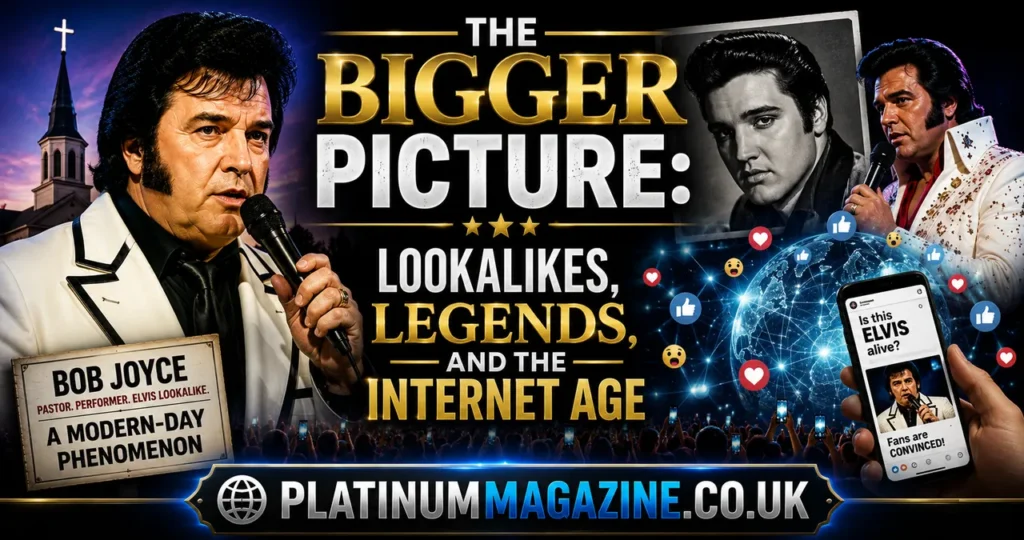
Bob Joyce isn’t the first person to be swept up in this kind of viral mistaken-identity storm, and he almost certainly won’t be the last. Professional Elvis tribute artists have made entire careers out of leaning into the resemblance deliberately, performing in Las Vegas showrooms and on cruise ships around the world. What sets the Bob Joyce Elvis case apart is that he never set out to be an Elvis impersonator at all; his resemblance was discovered and amplified by strangers online, almost entirely without his input, which gives the whole story a slightly different, more involuntary flavor than a typical tribute act.
That distinction matters for understanding why the theory took off the way it did. Deliberate impersonators invite comparison and expect it; there’s no mystery to solve because the premise is transparent from the start. Bob Joyce, by contrast, was simply living his life as a pastor when internet users stumbled onto the resemblance organically, which created the sense of an accidental discovery rather than a performance. That perceived authenticity, ironically, is exactly what made the conspiracy feel more plausible to casual viewers than it would have if Joyce had been marketing himself as an Elvis tribute act from day one.
It’s also a useful case study in how quickly unverified claims can attach themselves to a real, identifiable private individual. Bob Joyce didn’t ask to become the center of a global conspiracy theory, and the sustained attention has undoubtedly reshaped his and his family’s public life in ways they never anticipated. Whatever entertainment value the story holds for casual viewers, it’s worth remembering there’s a real person and a real congregation on the other end of every viral clip, one that continues to gather for services in Benton, Arkansas, largely unconcerned with the online debate swirling around its pastor’s face.
Read Also : Tom Cruise and Ana de Armas: Truth Behind the Romance Rumors
Conclusion
The Bob Joyce Elvis theory is a compelling example of how a striking physical resemblance, a similar singing voice, and a decades-old cultural mythology about a beloved icon can combine into a viral conspiracy theory that refuses to fully fade away. Bob Joyce is a real pastor from Benton, Arkansas, born in 1952, who leads the Household of Faith church with his wife, Willena, and has repeatedly and publicly denied any connection to Elvis Presley. The math simply doesn’t work: Elvis, born in 1935, would be well into his nineties today, while Joyce remains in his early seventies, a gap that alone undermines the entire premise of the theory.
Related claims, including the supposed sighting of Joyce at Lisa Marie Presley’s funeral, have been traced back to cases of mistaken identity involving other individuals with genuine ties to the Presley family. What remains true and undeniable is the resemblance itself, along with the vocal similarity that first caught the internet’s attention, and the very human desire among longtime fans to believe that some piece of Elvis Presley’s legend might still be out there, somewhere, refusing to let go. In the end, the Bob Joyce Elvis story says as much about our collective fascination with lost icons as it does about one soft-spoken preacher who simply happens to look and sound like the King.
Frequently Asked Questions About Bob Joyce Elvis
Is Bob Joyce actually related to Elvis Presley by blood?
There is no verified evidence connecting Bob Joyce to the Presley family by blood or by any documented lineage. The Bob Joyce Elvis rumors rest entirely on physical and vocal resemblance rather than any genealogical record, DNA test, or official confirmation from either family. Genetic look-alikes occur naturally throughout the population, and Joyce’s resemblance to Presley, while genuinely striking, doesn’t require a hidden family connection to explain.
Why does Bob Joyce sound so much like Elvis when he sings?
Vocal similarity between unrelated individuals isn’t unusual, particularly among singers from similar regional backgrounds performing similar genres like gospel and classic country. Joyce grew up in the American South, and his natural vocal tone, phrasing, and vibrato happen to align closely with Presley’s distinctive style, which is part of what made early clips of his singing spread so quickly. It’s a coincidence of biology and musical influence rather than evidence of a shared identity.
Has Bob Joyce ever confirmed the rumors himself?
No. Bob Joyce has consistently and publicly denied being Elvis Presley, including in statements made directly to his own congregation. He has described the situation as an unusual but ultimately harmless case of mistaken identity, and he has continued focusing on his ministry rather than engaging deeply with the conspiracy theories surrounding him.
Did Elvis Presley really fake his own death in 1977?
There is no credible medical, legal, or documentary evidence supporting the claim that Elvis Presley faked his death on August 16, 1977. His death was certified by medical examiners, confirmed by his family, and covered extensively by contemporary press. Conspiracy theories about a faked death have circulated for decades, largely fueled by the emotional shock of losing such a major cultural figure at a relatively young age, but they have never been substantiated by verifiable evidence.
Where can I learn more about the real facts of Elvis Presley’s life and death?
For a well-documented, thoroughly sourced overview of Elvis Presley’s career, personal life, and death, Wikipedia’s entry on Elvis Presley offers an extensively cited starting point that separates verified biographical facts from decades of tabloid speculation. Comparing that documented timeline against any Bob Joyce Elvis claim is one of the quickest ways to see how the age, dates, and circumstances simply don’t align.
Recommended For You: Karrueche Tran Baby Father


